







Most AI risk isn’t new—it’s inherited. Autonomous systems amplify the blast radius of weak identity, token, and access controls already in place. If your AI strategy is moving faster than your identity strategy, you are not deploying AI. You are handing attackers a faster way in. That is not a theoretical risk. It is already happening.
Over the past year, multiple high‑profile incidents have exposed the same uncomfortable truth. CIO Dive reported that the AI security readiness gap is widening as enterprises rush to deploy AI into production without a zero‑trust and identity foundation. A separate investigation showed how persistent OAuth tokens allowed attackers to bypass MFA and quietly move through more than 700 organizations via trusted third‑party integrations —and an AI tooling vendor recently told every customer to rotate sensitive keys after an upstream breach expanded their blast radius overnight.
Different headlines. One root cause. AI does not introduce a brand‑new security problem. It accelerates the identity failures you already have.
The Real AI Security Gap Is an Identity Gap
Most AI security conversations start in the wrong place. They focus on models: prompt injection, training data leakage, hallucinations, and guardrails. Those risks are real, but they are not where failures are happening at scale today.
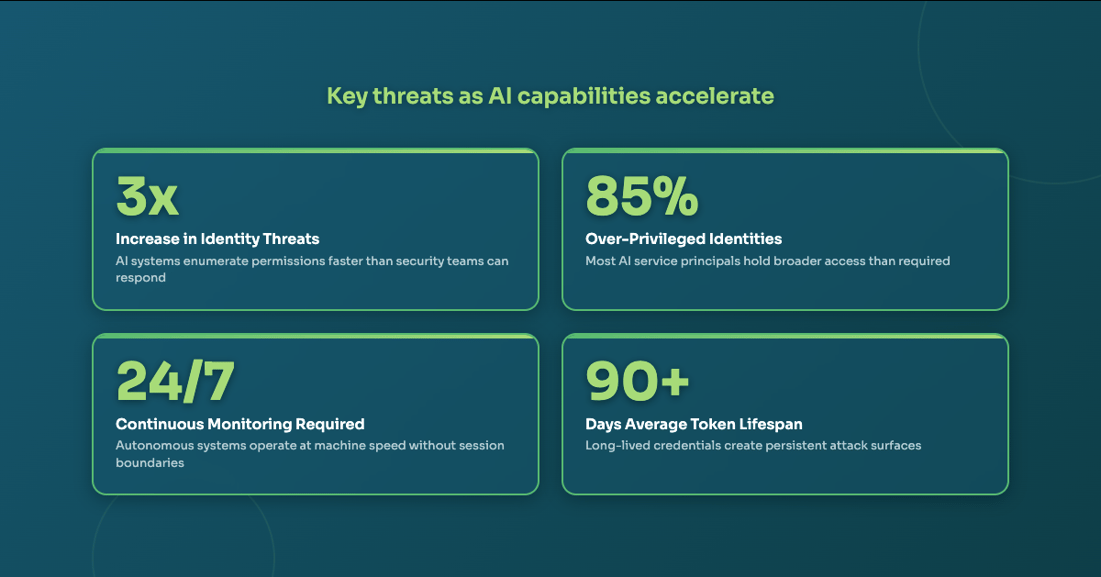
What actually connects these incidents is identity. AI systems do not break in by cracking models. They authenticate. They inherit OAuth grants. They reuse service principals. They act with long‑lived tokens that were never designed for autonomous, machine‑speed execution.
In the OAuth token abuse incidents, attackers did not defeat MFA. They used valid, previously issued tokens that did not require re‑authentication to be exercised. Once AI systems begin operating continuously, assumptions about session boundaries, token lifetime, and revocation speed collapse.
When an AI system runs with persistent credentials, identity is no longer just a control plane. It defines the blast radius.
Why Buying “AI Security” Tools Misses the Point
The market response to this moment has been predictable. New “AI security” products promise visibility, guardrails, and control layers on top of existing environments.
That approach feels comforting. It is also backward. You cannot bolt AI security onto a weak foundation. If your identity architecture cannot reliably answer who can act, for how long, under what conditions, and with what revocation guarantees, adding another tool only creates the illusion of safety.
This is where Redapt takes a contrarian position. AI security fails if it starts at the model layer and ignores identity, token lifecycle, and access foundations. AI does not eliminate the need for specialized controls—but those controls cannot work without a hardened identity layer underneath them.
AI magnifies whatever access model you already have. If that model is weak, AI will exploit it faster than any human ever could.
The Machine‑Speed Problem Executives Are Underestimating
Human breaches unfold over hours or days. AI‑driven failures unfold at machine speed. An AI system does not get tired. It does not hesitate. It does not question scope creep. If compromised, it will enumerate permissions, pivot across systems, and act faster than incident response teams can react.
Identity is the enforcement surface that determines which data an AI system can access, under what conditions, and with what auditability. If that surface is unclear or over‑permissive, AI does not just increase risk—it operationalizes it.
That is why securing identity first is not conservative. It is the fastest safe path to AI adoption.
A Simple Identity Readiness Check Before You Deploy AI
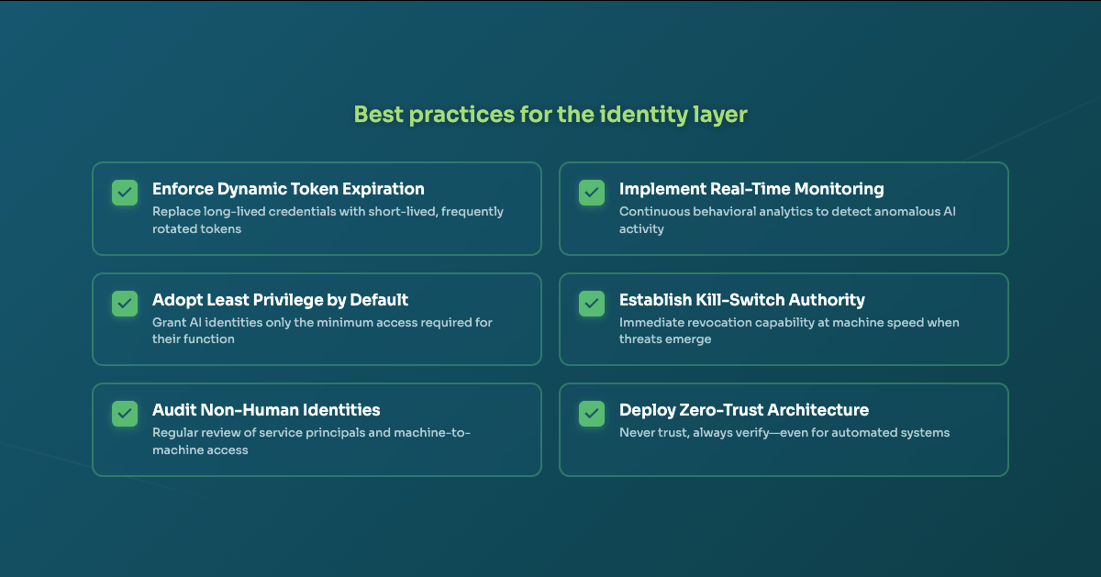
Before deploying AI agents, copilots, or autonomous workflows, every CIO, CISO, and CDO should be able to answer three questions with confidence:
Credential lifespan:
Which non‑human identities in your environment use long‑lived tokens or keys, and how are they revoked when behavior or risk changes?
Scope discipline:
Can every AI‑accessible identity be traced to least‑privilege intent, or are broad grants accumulating silently across data and systems?
Kill‑switch authority:
If an AI system starts behaving unexpectedly, who can shut it down immediately—and how is that enforced at the identity and access layer?
If those answers are unclear, the risk is not theoretical. It is structural.
Foundations Before Features
Redapt’s position is simple: zero‑trust and identity hardening must come before AI deployment, not after.
Our Identity & Zero‑Trust Posture Audit is designed to surface exactly the gaps AI will exploit first—credential persistence, over‑privileged access, weak revocation paths, and unclear ownership. The audit does not slow AI adoption. It removes the hidden risks that would otherwise force you to slam the brakes later.
Once the foundation is secure, that same work naturally flows into a full AI Readiness Assessment, where architecture, governance, and scale decisions can be made with confidence rather than urgency.
AI rewards speed. But it punishes weak identity faster than any previous wave of technology. If you want AI to move at machine speed for your business—not against it—start where the real risk lives.
Book a Redapt Identity & Zero‑Trust Posture Audit to assess and harden your environment before AI systems act on your behalf.
Transition seamlessly into a full AI Readiness Assessment once your identity foundation is secure.