







Two realities are colliding in enterprise AI adoption.
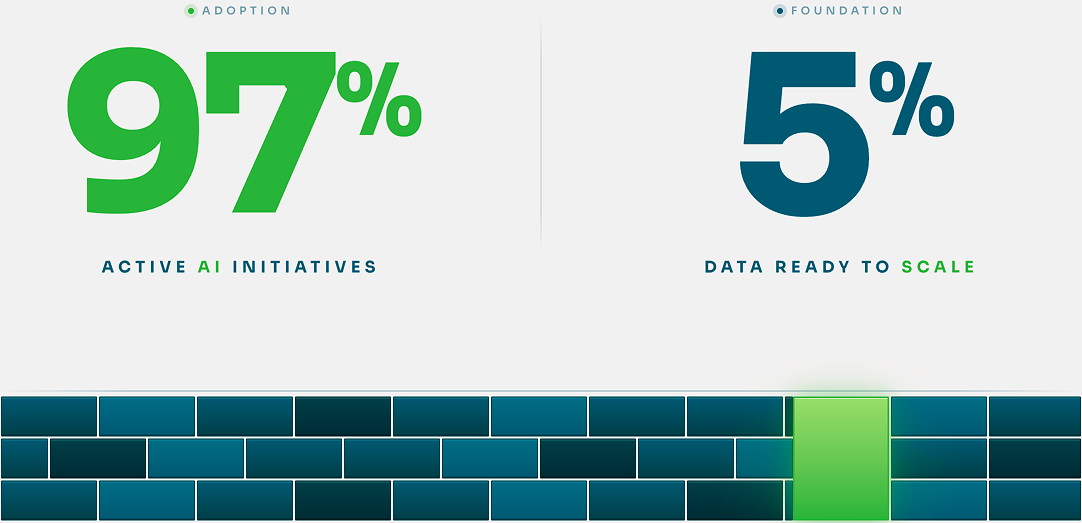
First: AI is now a line item in almost every roadmap. Dun & Bradstreet reports 97% of organizations have active AI initiatives — but only 5% say their data is ready to support them at scale.
Second: the easiest thing to measure in an AI program is activity — prompts, seats, token spend, and “active users.” Many enterprises are now closely tracking AI usage, even when they can’t yet connect it to business outcomes with confidence.
The result is predictable: teams optimize for what’s visible. Leaders get dashboards that look like momentum. The business still struggles to get durable value into production.
Platforms are rarely the constraint. Foundations are.
What the 5% number means (and why it blocks scale)
When leaders hear “data isn’t ready,” they often picture cleanup: duplicates, missing fields, inconsistent schemas. That’s part of it, but it’s not the main reason AI stalls.
The deeper blockers look like this:
Data access is constrained. Half of the organizations in the D&B survey cite limited access to data as a leading obstacle.
Privacy and compliance pressure rise fast. The same survey highlights privacy and compliance risk as a major barrier, which becomes acute the moment AI touches regulated or customer-sensitive workflows.
Integration gaps prevent “enterprise” AI. If your systems can’t reliably resolve entities and share context across domains, you can run pilots — but scaling into mission‑critical workflows becomes fragile.
This is why many organizations can demo AI and still fail to operationalize it. You can build impressive prototypes on partial data. You can’t run enterprise AI reliably without governed data foundations and a control model that leadership can defend.
Why activity metrics mislead leadership
AI adoption has a measurement trap: the numbers that are easiest to produce are the least predictive of value.
Prompts, active seats, and token spend can show engagement, but they don’t tell you whether AI is improving performance, reducing risk, or changing decisions. And when those metrics become targets, you get gaming behavior.
Public reporting has already shown how this plays out in practice. At Amazon, employees reportedly ran unnecessary tasks through internal AI tools to inflate usage statistics under pressure to adopt — a textbook example of what happens when a proxy metric becomes a scoreboard.
More broadly, tracking AI usage has expanded, even though many organizations still struggle to prove ROI beyond estimates.
The leadership alternative is simple, but harder: measure outcomes.
- What decisions changed because of AI?
- What cycle time dropped in a workflow that matters?
- What defects, anomalies, or risks were caught earlier?
- What cost volatility was reduced because governance improved?
If you can’t answer those, usage is noise.
The “81% review tax” is a scaling signal, not a tooling problem
One of the clearest indicators that foundations matter is what engineering teams report after adopting AI coding tools.
A 2026 report from Harness (surveying 700 engineering practitioners and managers) found 81% of engineering leaders say the time “saved” by AI coding tools is now spent auditing AI output.
That’s not an argument against AI. It’s evidence that scaling AI without guardrails shifts work — it doesn’t remove it.
When AI output is produced without reliable context, consistent standards, and clear accountability, humans become the compensating control. Review time rises. Security scrutiny increases. Risk owners’ slow approvals. The organization experiences “AI work” without “AI outcomes.”
Leaders should treat this review tax as a diagnostic: it points to missing governance, standards, and operating model discipline—not insufficient model capability.
The leadership POV: AI maturity follows your operating model
AI programs don’t fail because leadership picked the wrong platform. They fail because organizations skip the work that makes any platform safe to scale.
A defensible AI adoption approach looks less like “deploy copilots everywhere” and more like “build an operating model that earns trust.”
That operating model has three non‑negotiables:
- Governance and risk management are designed in, not bolted on. NIST’s AI Risk Management Framework reinforces that trustworthy AI depends on structured risk management across design, deployment, and ongoing evaluation — not one-time policy statements.
- Data foundations are treated as product infrastructure. D&B’s survey makes clear that access, integration, and compliance constraints are what block scale, not a shortage of platforms.
- Measurement ties to outcomes, not activity. If adoption dashboards can’t connect to business results, you will get adoption theater.
This is the shift leaders need to make: from “AI adoption” to “AI operations.”
What an AI readiness scorecard should cover in 2026
Leadership teams need a readiness model that looks like an enterprise system, not a vendor checklist.
Microsoft’s AI Readiness Assessment defines seven pillars that are broadly applicable to any organization scaling AI:
-
Business Strategy
-
AI Governance & Security
-
Data Foundations
-
AI Strategy & Experience
-
Organization & Culture
-
Infrastructure for AI
-
Model Management
That structure works because it forces the right conversations:
- Are we aligned on the idea that AI changes decisions, not just tasks?
- Do we have governance that matches the risk level of each use case?
- Are data foundations mature enough to support scaled workflows?
- Can we manage models in production (monitoring, drift, evaluation), not just pilots?
- Does the organization have the change capacity to absorb workflow redesign?
If any of those are weak, scaling will be slower and more expensive than leadership expects — even if usage metrics look strong.
The stage‑gated rollout leaders can defend
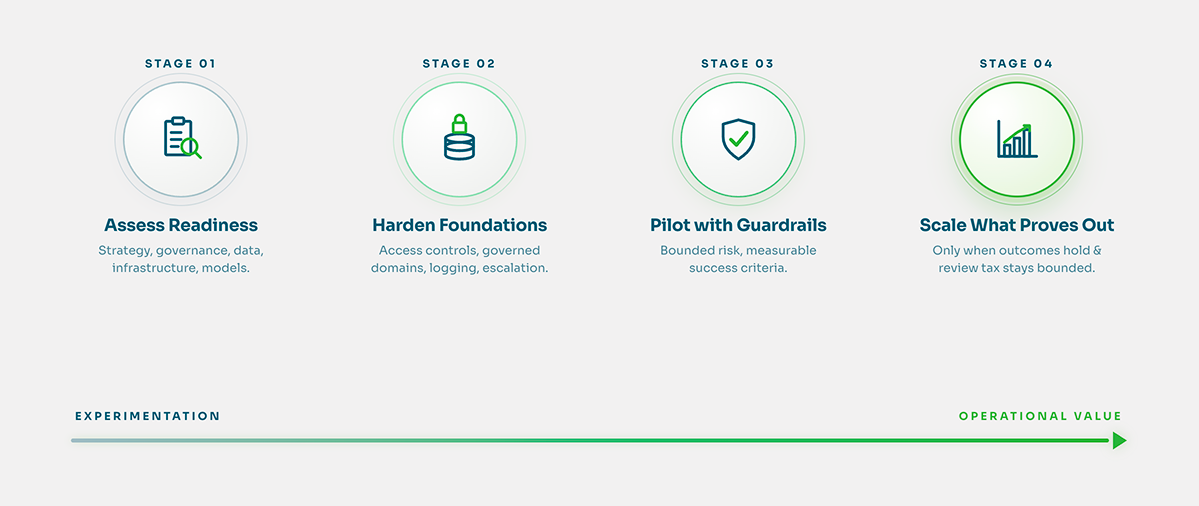
The organizations that successfully deploy AI to production reliably follow a staged approach. Not because they’re cautious — because they’re accountable.
- Assess readiness against strategy, governance/security, data foundations, infrastructure, and model management.
- Harden foundations where constraints are deal‑blocking: access controls, governed data domains, logging/monitoring, and clear escalation paths.
- Pilot with guardrails in workflows where success criteria are measurable and risk is bounded.
- Scale what proves out only when outcome metrics hold under real load — and when review overhead stays controlled rather than exploding.
This is how leadership moves from experimentation to operational value — and how you stop rewarding AI activity while starving AI outcomes.
Before you scale your next AI platform decision, get a readiness readout you can defend.
Data Readiness Workshop — a structured assessment that surfaces the foundation gaps blocking AI from moving beyond pilots and clarifies what to fix first (and what not to deploy yet).


.png?width=352&name=How%20to%20Scale%20AI%20Systems%20Without%20Compromising%20Security(1).png)