





A production line that goes down mid-shift doesn't wait for your migration plan to catch up. That's the specific fear behind almost every cloud migration conversation in manufacturing — and it's why so many of them stall before the first workload moves.
Manufacturing IT leaders aren't afraid of the cloud. They're afraid of cutovers. The moment a critical system hasn't come back up. The shift was lost. The shipment missed. The call from a plant manager at 2 AM asking why the ERP is offline.
That fear is rational. And it's why the standard advice — "move fast; the cloud is stable" — fails every time someone has to defend the plan to operations.
The pressure isn't going away. SAP S/4HANA migration deadlines are real. Data center lease expiry doesn't allow negotiation. Broadcom's pricing is forcing IT teams to make decisions they weren't ready to make on a timeline they didn't choose. Leadership watching those bills climb is not interested in a three-year roadmap.
The result is a planning paralysis that looks like caution but is actually a data problem. Teams don't have enough visibility into their own environments to make a confident call on wave sequencing, dependency risk, or what happens if a cutover goes wrong. So, they delay. The delay burns co-fund eligibility windows. The migration gets scoped down. The problem doesn't shrink — it gets more expensive.
The Teams That Get Through It Sequence Differently
The manufacturing IT leaders who complete a migration without the political fallout don't resolve the uptime-versus-speed tension by picking one. They separate the two problems and solve them independently.
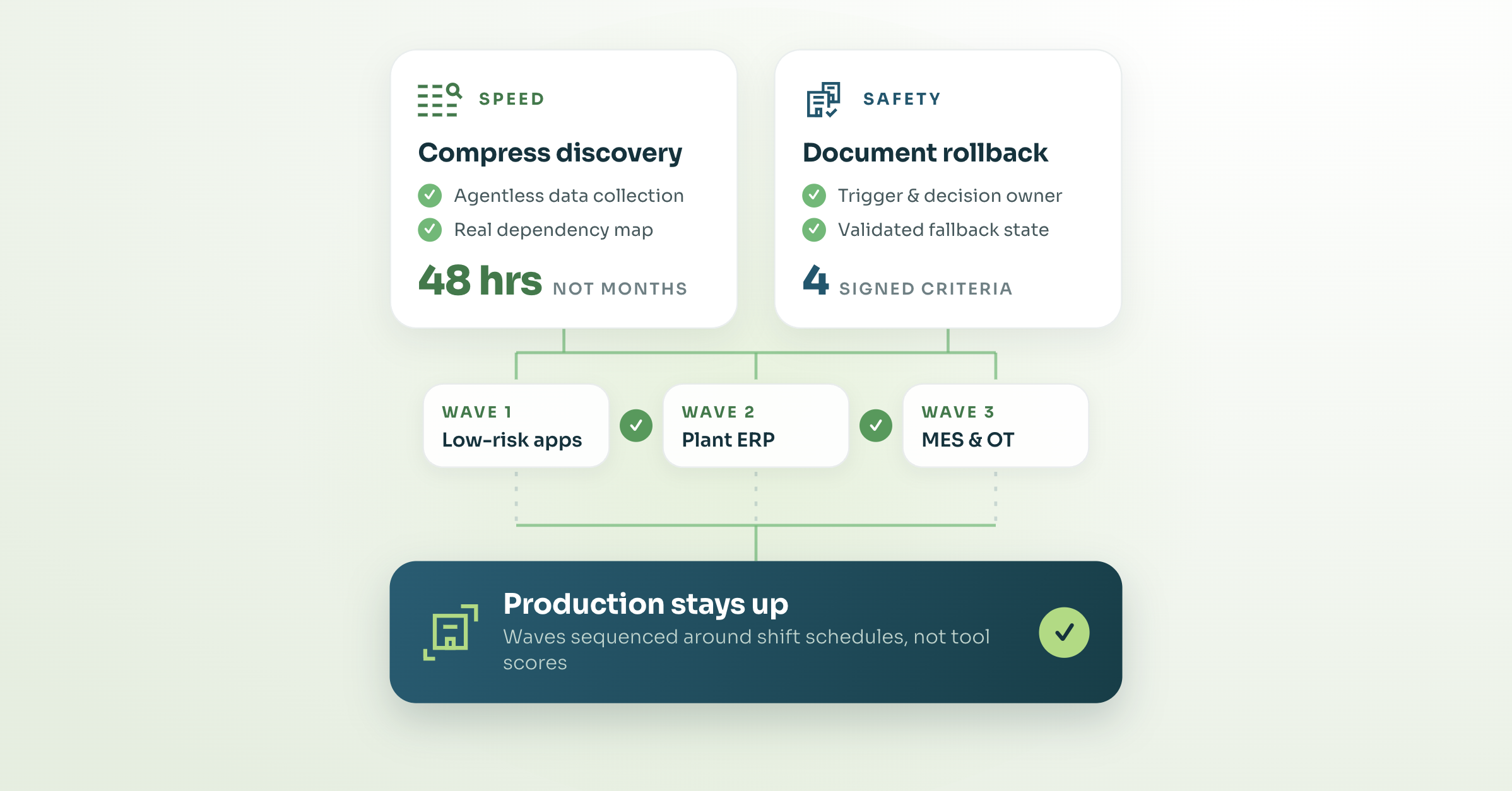
Speed comes from compressing discovery. Most manufacturing migrations spend months in pre-planning because the assessment process is manual — someone walking the data center with a spreadsheet, cross-referencing with application owners, and guessing at dependencies. AI-driven discovery tools can replace that process in days. That's part of the timeline that should be compressed.
Safety comes from documenting rollback criteria before the first wave is set. Not a rollback as a slide in a deck. Rollback as a signed artifact: the success criteria for the cutover, the threshold that triggers the decision, the person with authority to call it, and the validated fallback state. That cannot be compressed, and it shouldn't be.
When discovery is fast, and rollback is rigorous, you can defend both the pace and the risk posture to operations leadership — because they aren't competing priorities. They're different work.
Where Manufacturing Migration Plans Break Down
The application dependency map is wrong — or missing entirely. SAP environments with decades of customizations, plant-level ERP instances, MES integrations, and OT touchpoints have dependencies that no one has fully documented. A wave plan built on an incomplete dependency map fails at the first cutover when something upstream drops that no one knew was connected.
The rollback criteria are assumptions, not artifacts. "We can roll back" is not a rollback plan. Absent a documented decision framework — trigger, authority, fallback state — rollback in a manufacturing environment is emergency scrambling. And emergency scrambling in a plant context doesn't stay inside the IT department.
The sequence is driven by what's easiest to move, not by what operations actually depend on. Migrations that prioritize technical simplicity routinely hit the OT-adjacent systems — the ones plant managers care about — late in the program, when runway has been consumed, and appetite for disruption is exhausted. By then, the conversation with operations is adversarial.
Redapt has delivered more than 1,000 complex cloud migrations. The pattern that gets manufacturing teams through without the operational and political fallout is consistent: structured discovery before scope is fixed, wave plans built from dependency data rather than application owner estimates, and rollback criteria documented before the contract is signed — not after the first cutover is scheduled.
Three Decisions Worth Making Before Scope Is Fixed
Map before you commit. An executable wave plan requires an actual dependency map — not a self-reported application inventory. AI-driven discovery tools can process millions of data points to assess your entire infrastructure and application environment, with agentless data collection and actionable insights within 48 hours. If your assessment doesn't start there, your first wave plan is a guess dressed up as a plan.
Write the rollback criteria before you set the migration date. For every workload that touches production, the rollback artifact should exist before the cutover date is selected, including the success threshold, trigger event, decision authority, and fallback state. If you can't write those four things down, the wave isn't ready to move.
Sequence by operational dependency, not technical simplicity. Pull in plant operations early. The workloads they care about — ERP production instances, MES integrations, historian systems — should be sequenced around maintenance windows and shift schedules, not around what a migration tool scores as lowest risk. The migration that operations leadership will defend is the one they helped sequence.
None of this requires a new vendor or a new tool at the start. It requires a different conversation before the scope is fixed, before the budget is committed, and before the wave plan becomes a political document that no one wants to revise.
If your migration is already planned and those questions don't have clear answers, that's worth a conversation before the first wave moves forward.
If you're still in assessment, the dependency map and co-fund eligibility picture should be visible before that window closes.
Request an Architecture Review. We'll evaluate your current environment and plan, identify where the dependency and rollback gaps are, and deliver documented findings of output — not a pitch deck. The findings are yours regardless of what comes next.