







Trust isn’t declared. It’s built decision by decision, over decades.
Thirty years in technology is enough time to see cultures rise, fade, and get reinvented. Tools change. Markets shift. Business models evolve. What tends to endure is not a playbook—but a set of behaviors people can rely on when conditions change.
At Redapt, our culture has matured over three decades. But at its core, it has always been entrepreneurial. Not reckless. Not loud. Entrepreneurial in the sense that people take responsibility, adapt to reality, and solve the problem in front of them—without waiting to be told.
That mindset shows up everywhere, especially with our customers.
Service, Not Sell—As a Cultural Choice
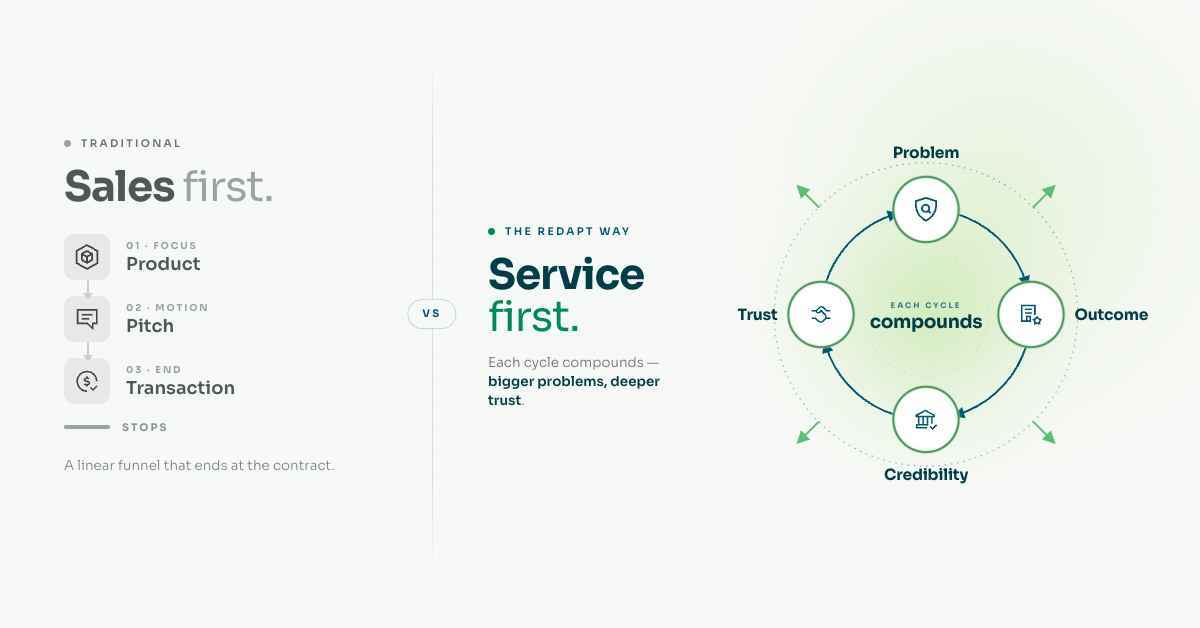
“Service, Not Sell” isn’t a positioning statement we arrived at later. It’s how relationships were formed naturally when Redapt was small, resource‑constrained, and dependent on trust to survive.
That orientation shaped the culture internally long before it became customer‑facing.
People who thrive at Redapt understand something early:
Our success follows our customers’ success—not the other way around.
When customers choose to work with us and achieve their outcomes, two things happen at once. The organization moves forward. And the technologists who partnered with us built credibility inside their own teams and leadership circles. That reputational lift matters. We treat it as part of the work.
When outcomes are delivered this way, trust compounds. And trust earns the opportunity to keep building together—on the next initiative, and the one after that.
One Culture. Inside and Out.
Some organizations behave one way with customers and another way internally. Redapt doesn’t.
The culture customers experience is the same one our teams operate in every day. That consistency matters. It’s how trust scales.
Internally, we operate on a simple leadership framework called Extreme Ownership. The title sounds aggressive, but the principles are simple, straightforward, and effective.
Two concepts tend to surprise people when they first join.
Everyone Can Lead
Leadership at Redapt isn’t tied to title or tenure. If you see a problem and understand the context, you’re expected to engage with it. Waiting for permission is rarely the right move. Leading up the chain is not only acceptable—it’s necessary.
No Silos
Work moves across teams based on what the outcome requires, not whose number benefits. Teammates support each other across business units because it’s good for the customer and good for the company. Metrics don’t disappear—but they never outrank the result.
At some companies, protecting your number comes first.
Here, protecting the outcome does.
What Longevity Really Signals
.jpg?width=807&height=422&name=Tenure-Comparison%20-%20Blog3%201200x628%20(2).jpg)
The technology industry is known for movement. Average tenure in tech roles typically ranges from 2 to 3 years, significantly shorter than the median tenure in the U.S. workforce as a whole.
Against that backdrop, Redapt’s longevity tells a quieter story.
We’ve been in business for 30 years. And we still work alongside people who have been here for decades.
That doesn’t happen by accident. In an industry full of attractive options, people stay when they trust the environment they’re in—when ownership is real, collaboration is genuine, and success is shared.
Culture as a Strategic Advantage
A people‑first, outcome‑driven culture isn’t soft. It’s durable.
It allows Redapt to adapt without losing its identity. It enables teams to co-innovate with customers, not push innovation at them. And it creates relationships—internally and externally—that hold up when the work gets hard.
That’s what standing the test of time looks like.
If you’re facing a challenge where trust, ownership, and execution matter, let’s work through it together.
We’ll start with the problem—not the pitch.
/data-capital-webinar_mockup.png?width=352&name=data-capital-webinar_mockup.png)